


Shafts are among the most critical components in mechanical engineering, power transmission, automation equipment, and precision machinery. Shaft machining is the precision manufacturing process of producing cylindrical, stepped, or custom-shaped shafts through a series of machining operations—including turning, milling, grinding, and finishing. The quality of shaft machining directly determines the stability, operational efficiency, service life, and safety of the entire equipment system.
This comprehensive guide covers core aspects of shaft machining, including material selection, machining methods, design principles, quality control, and typical applications. It is designed to help engineers, purchasers, and industry professionals make informed decisions for their specific project needs.
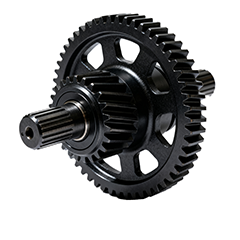
Common Shaft Materials & Selection Criteria
The choice of shaft material is critical to meeting performance requirements, and it depends on factors such as load capacity, rigidity, wear resistance, corrosion resistance, weight constraints, and production cost. Below are the most widely used materials for shaft machining and their key characteristics:
Carbon Steel
1045 (S45C): The most commonly used carbon steel for general shafts. It offers good strength, toughness, and excellent machinability. After simple heat treatment (quenching and tempering), it can meet the requirements of most general mechanical applications.
Applications: General mechanical shafts, gear shafts, transmission shafts, connecting shafts, and low-to-medium load components.
Alloy Steel
40Cr: A medium-carbon alloy steel with good hardenability, strength, and fatigue resistance. It is widely used in shafts that require higher load-bearing capacity than carbon steel.
42CrMo: A high-strength alloy steel with excellent toughness, wear resistance, and fatigue life after heat treatment. It is suitable for high-load, high-speed, and high-temperature working conditions.
Applications: High-load shafts, motor shafts, automotive drive shafts, reducer shafts, and precision mechanical components.
Stainless Steel
303, 316: Austenitic stainless steels with excellent corrosion resistance, hygiene, and machinability. 316 stainless steel offers superior corrosion resistance in harsh environments (e.g., marine, chemical).
416, 420: Martensitic stainless steels with good hardness and wear resistance after heat treatment, suitable for shafts requiring both corrosion resistance and strength.
Applications: Food machinery shafts, medical equipment shafts, marine components, semiconductor equipment shafts, and parts used in humid or corrosive environments.
Aluminum Alloy
6061, 7075: Lightweight aluminum alloys with good machinability, moderate strength, and corrosion resistance. 7075 is a high-strength aluminum alloy suitable for lightweight, high-load applications.
Applications: Light-duty shafts, robotics components, aerospace parts, and portable equipment shafts where weight reduction is critical.
Brass & Copper Alloys
C3604, H59, H62: Copper alloys with excellent machinability, corrosion resistance, and electrical conductivity. They are easy to process and have good surface finish.
Applications: Low-load shafts, electrical components, instrument shafts, and parts requiring good conductivity and corrosion resistance in low-stress environments.
Key Material Selection Rules
High load or fatigue requirements → Alloy steel (42CrMo, 40Cr)
Corrosive environments (marine, chemical, food) → Stainless steel (303, 316)
Lightweight requirements (aerospace, robotics) → Aluminum alloy (6061, 7075)
General transmission or low-load applications → Carbon steel (1045)
Electrical or low-stress components → Brass/copper alloys
2. Shaft Machining Methods & Standard Processes
Shaft machining requires strict control of precision (concentricity, cylindricity), surface finish, and dimensional accuracy. Below are the core machining methods and a typical production flow for precision shafts:
1 Core Machining Methods
CNC Turning (Core Process)
The primary process for shaft manufacturing, used to machine outer diameters, steps, grooves, threads, chamfers, tapers, and other rotational features.
Equipment: CNC lathes, Swiss-type lathes (for small-diameter, high-precision shafts).
Precision: ±0.01mm for standard shafts; ±0.005mm for high-precision shafts.
CNC Milling
Used to machine non-rotational features on shafts, such as flats, slots, keyways, holes, cams, and custom profiles.
Equipment: 3-axis, 4-axis, or 5-axis CNC milling machines.
Application: Complex shafts with integrated features (e.g., gear shafts with keyways, camshafts).
Cylindrical Grinding / Centerless Grinding
A finishing process to improve roundness, straightness, and surface finish of shaft surfaces—especially critical for bearing journals and high-precision mating surfaces.
Equipment: Cylindrical grinders, centerless grinders.
Precision: ±0.001mm, surface roughness Ra ≤ 0.2μm.
Application: High-speed shafts, bearing positions, and shafts requiring tight dimensional tolerance.
Heat Treatment
A critical step to improve the mechanical properties of shafts, including hardness, wear resistance, and fatigue life.
Common processes: Quenching & tempering (for strength and toughness), carburizing (for surface hardness), induction hardening (for local hardening of key surfaces).
Finishing & Surface Treatment
Polishing: Improves surface finish (Ra ≤ 0.1μm) for high-precision or decorative shafts.
Passivation: Enhances corrosion resistance of stainless steel shafts.
Plating (Chrome, Nickel): Improves wear resistance and appearance.
Sandblasting: Creates a uniform matte surface for aesthetic or functional purposes.
2 Typical Shaft Machining Flow
Material cutting (sawing or shearing) → Cut raw material to required length.
CNC rough turning → Remove excess material and shape the basic shaft profile.
Heat treatment (if required) → Improve mechanical properties.
Semi-finish turning → Refine dimensions and prepare for grinding.
CNC milling → Machine non-rotational features (flats, slots, keyways).
Cylindrical/centerless grinding → Finish critical surfaces to meet precision requirements.
Finishing & surface treatment → Improve surface quality and corrosion resistance.
Quality inspection → Verify dimensions, precision, and surface quality.
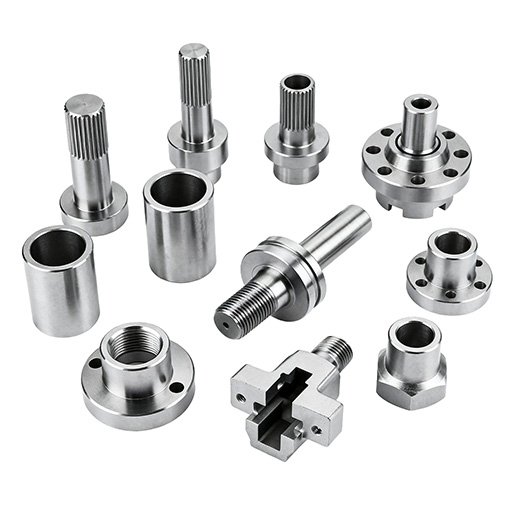
3. Shaft Design Guidelines for Machinability & Performance
A well-designed shaft not only meets performance requirements but also reduces machining difficulty, lowers production costs, and extends service life. Below are key design principles for machinable, high-performance shafts:
1 Tolerance & Fit Design
Bearing positions: Use tight tolerances (h6, g6, f7) to ensure smooth rotation and reduce wear.
General fitting parts: Use standard tolerances (h7, h8) for cost-effectiveness.
High-precision mating surfaces: Require grinding to achieve tight tolerances and good surface finish.
2 Surface Roughness Requirements
Bearing journals: Ra 0.2–0.8μm (requires grinding).
Gear or spline positions: Ra 0.8–1.6μm (ensures smooth meshing and wear resistance).
General surfaces (non-mating): Ra 1.6–3.2μm (meets basic functional requirements).
3 Avoid Stress Concentration
Avoid sudden changes in diameter—use fillets (R ≥ 1mm) or rounded corners at step transitions to distribute stress.
Prevent sharp edges, as they can cause stress concentration and lead to shaft breakage under high speed or load.
4 Reasonable Groove & Step Design
Standardize groove width and depth to simplify machining and reduce tool wear.
Avoid overly deep or narrow grooves (width < 1mm, depth > 5mm) that are difficult to machine and may weaken the shaft.
5 Concentricity & Runout Control
Concentricity is critical for high-speed shafts—control radial runout within 0.005–0.02mm.
Use center holes (live centers) during machining to ensure coaxiality of multiple shaft sections.
6 Machining Allowance
Reserve appropriate grinding allowance for precision shafts: 0.2–0.5mm per side (varies by shaft diameter and precision requirements).
Avoid excessive allowance, which increases machining time and cost.
4. Key Quality Control in Shaft Machining
Precision shafts require strict quality control throughout the machining process to ensure consistency and performance. Key inspection items include:
Dimensional accuracy: Outer diameter, length, groove size, thread pitch, and step height.
Form accuracy: Roundness, straightness, and cylindricity (critical for bearing journals).
Position accuracy: Concentricity, coaxiality, perpendicularity (for keyways and holes), and radial runout.
Surface quality: Surface roughness, scratches, cracks, and other defects.
Material & hardness: Material composition verification (certificate of analysis), hardness testing (Rockwell/CBrale), and heat treatment quality.
Non-destructive testing (NDT): For high-performance or safety-critical shafts (e.g., ultrasonic testing, magnetic particle testing) to detect internal defects.
Common inspection equipment: Coordinate Measuring Machine (CMM), surface roughness tester, hardness tester, dial gauge, and micrometer.
5. Typical Applications of Precision Machined Shafts
Precision machined shafts are used in almost every industrial sector, including:
Power transmission: Motors, generators, reducers, gearboxes, and transmission shafts.
Automotive industry: Drive shafts, camshafts, crankshafts, and steering system shafts.
Robotics & automation: Robot arm shafts, linear motion shafts, and servo motor shafts.
Medical & food machinery: Sterile shafts for medical devices, hygiene-grade shafts for food processing equipment.
Industrial equipment: Pumps, compressors, fans, and machine tool spindles.
Aerospace & optical equipment: Lightweight, high-precision shafts for aircraft and optical instruments.
6. Why Choose a Professional Shaft Machining Partner?
High-quality precision shafts require advanced equipment, mature processes, and strict quality control. A professional shaft machining partner offers the following advantages:
Advanced equipment: CNC lathes, Swiss-type lathes, high-precision grinders, and multi-axis machining centers to handle complex and high-precision shafts.
Technical expertise: Experienced engineers to optimize material selection, design, and machining processes for cost-effectiveness and performance.
Strict quality control: Full-process inspection (from raw material to finished product) and compliance with international standards (ISO 9001, IATF 16949 for automotive).
Flexible production: Ability to produce small batches, large batches, and custom shafts (long shafts, thin shafts, complex shafts) to meet diverse customer needs.
Comprehensive support: One-stop service including material procurement, heat treatment, surface treatment, and after-sales technical support.
7. Summary
Shaft machining is a precision-driven process that combines material selection, advanced machining methods, and rational design to produce high-performance shafts. The key to successful shaft machining lies in choosing the right material for the application, optimizing the design for machinability, and implementing strict quality control throughout production.
For precision shafts used in automation, automotive, medical, and aerospace applications, partnering with a professional machining manufacturer ensures consistent quality, on-time delivery, and cost-effectiveness.


