


In the globalized manufacturing landscape, optimizing the CNC (Computer Numerical Control) machining supply chain has become a key pillar for enterprises to maintain technological leadership, cost control, and market responsiveness. Its advantages are not only reflected in the precision machining capabilities of individual stages but also permeate the entire value chain from design to delivery.
Driven by its high precision and modern technology, CNC machining services are becoming an important part of modern production. CNC machining is helping to reshape production and supply chains, from achieving superior precision in production to accelerating prototyping and manufacturing technologies.
In this comprehensive guide, we will introduce the applications of CNC machine tools, revealing various aspects of their applications and basic strategies for improving the supply chain
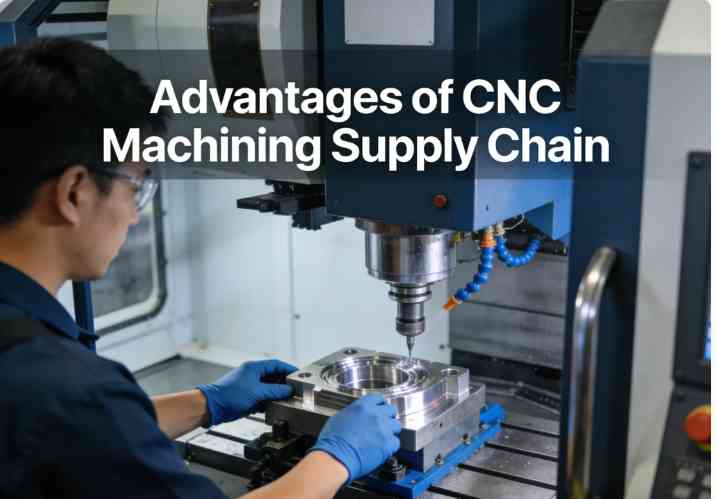
What are CNC Machining Services?
Computer Numerical Control Machining Services are automated precision machining services based on computer program control. Through pre-programmed digital instructions, the machine tool's cutting tool or workpiece is driven to move precisely in three-dimensional space, removing excess material from the blank and ultimately manufacturing precision parts or products that meet design requirements.
Key Features:
Digitally Driven: CAD models are the starting point, and CAM software generates machining code (G-code).
Automated Execution: Machine tools automatically complete complex operations such as cutting, drilling, and milling.
High Precision Guarantee: Typically achieves ±0.01-0.05mm accuracy; micron-level accuracy is possible for special applications.
Wide Range of Materials: Covers hundreds of engineering materials including metals, plastics, and composite materials.
Types of CNC Machining Services:
A comparison table of CNC machining services is provided for a more intuitive understanding:
| Service Type | Key Technical Features | Typical Applications |
|---|---|---|
| 3-Axis Machining | Linear motion along X/Y/Z axes, most basic configuration | Flat parts, simple contours, 2D features |
| 4-Axis Machining | Added rotational axis (A-axis or B-axis) | Cylindrical surface machining, side holes, simple curved surfaces |
| 5-Axis Simultaneous Machining | Three linear axes + two rotational axes moving simultaneously | Impellers, turbines, aerospace complex components |
| Turn-Mill Combination | Integration of turning and milling functions | Shaft-type parts, complex rotational bodies completed in one clamping |
| Swiss-Type Lathe | Spindle movement + guide bushing technology | Slender shaft parts, precision medical device components |
| Multi-Spindle Machine Tool | Multiple spindles machining synchronously | High-efficiency production of small parts in large batches |
Benefits of Using CNC Machining Services
Manufacturing Complex and Precision Structures:
CNC machining services accurately translate digital designs into physical entities, enabling the creation of complex geometric shapes that are difficult to achieve using traditional machining methods. Through multi-axis linkage technology, parts with features such as curved surfaces, oblique holes, and irregular cavities can be machined in a single setup, ensuring precise positional relationships between features. Systematic process control ensures high consistency of parts, with minimal dimensional fluctuations during mass production, meeting the stringent requirements of precision assembly. For high-end fields such as aerospace and medical devices, this stable, high-quality output is the fundamental guarantee of product reliability.
Improved Product Development and Iteration Efficiency
The conversion process from design drawings to physical parts is greatly simplified. After the design team completes the 3D model, the machining service provider can quickly perform process analysis and generate machining code, eliminating lengthy steps such as traditional mold manufacturing. This shortens the prototype verification cycle from weeks to days, allowing product improvements to be rapidly advanced based on actual samples. During small-batch trial production, machining parameters and process paths can be flexibly adjusted, design defects can be optimized in a timely manner, significantly reducing R&D trial-and-error costs and time risks, and accelerating the market launch of innovative products.
Establishing a Flexible and Efficient Production Supply System
Enterprises can dynamically allocate machining capacity according to market demand without bearing the high costs of purchasing and maintaining CNC equipment. This on-demand model is particularly suitable for industries with significant order fluctuations, avoiding resource waste caused by idle equipment. When a product needs to be upgraded, only the design files need to be updated to start a new batch of production, without the sunk costs of traditional mold scrapping. Geographically distributed machining networks also enable localized production, reducing logistics links and building a more resilient supply chain.
Professional Process Knowledge and Technical Resources
Professional CNC machining service providers have accumulated rich process databases across industries and multiple materials. Enterprises can directly apply proven tool selection schemes, cutting parameter optimization strategies, and fixture design solutions, avoiding redundant exploration. Service providers' continuous investment in advanced equipment upgrades and technical training allows customers to access cutting-edge technologies such as five-axis machining, composite material processing, and micro-machining, technologies that would require long-term accumulation and significant investment to develop independently.
Optimizing the Overall Cost Structure
While the cost of single-piece machining may be higher than that of mass-produced molds, considering the entire lifecycle costs including mold development, equipment depreciation, personnel training, and quality control, CNC machining is significantly more economical in small-to-medium batch production scenarios. Digital process planning maximizes material utilization and reduces waste through intelligent nesting. Precise process control reduces defect rates and quality losses. Enterprises can concentrate limited resources on core design and market development, achieving more optimized resource allocation.
Supporting Strict Quality Control
A mature CNC machining service system establishes a complete quality control process, from raw material traceability and process monitoring to final inspection, forming a traceable quality record. This is crucial for products requiring industry certifications such as AS9100 and ISO13485. Digital recording of machining parameters provides objective evidence for process verification, and professional measuring equipment (such as coordinate measuring machines) ensures data accuracy. These are fundamental conditions for meeting the compliance requirements of modern manufacturing.
Sustainable Manufacturing
CNC machining reduces raw material consumption through precise material removal, and optimized cutting strategies reduce energy consumption. Many service providers have established cutting fluid circulation systems and metal scrap recycling systems to reduce environmental pollution. The digital manufacturing model itself reduces the need for sample transportation, lowering the overall carbon footprint of the product development stage. This environmentally friendly characteristic is becoming an important consideration for more and more companies when choosing supply chain partners.
Foundation of Digital Manufacturing
Every CNC machining operation is a physical realization of design data, naturally forming a digital archive of product manufacturing. This machining data can be linked to subsequent quality and usage data, laying the foundation for product lifecycle management. With the popularization of digital twin technology, this precise recording of the manufacturing process will become a key link in the synchronous updating of virtual models and physical entities. Choosing professional CNC machining services essentially provides an interface for enterprises to access a broader intelligent manufacturing ecosystem.
The value of CNC machining services has transcended simple "outsourcing"; it essentially provides businesses with a plug-and-play system of precision manufacturing capabilities. This service model allows companies of all sizes to equally access cutting-edge manufacturing technologies, focusing limited resources on core innovation and collectively driving the entire manufacturing industry towards greater efficiency, intelligence, and sustainability. In a market environment where personalized customization is increasingly becoming mainstream, this flexible and efficient manufacturing service is redefining the path from product concept to market.


