


Meeting stringent tolerances, from precision plastic parts to complex metal components, remains a core challenge in manufacturing. Across various industries, ensuring consistent machining results and uniform surface finish directly determines the final part's performance and reliable lifespan. Face milling technology is the classic solution to this challenge. With its exceptional precision and efficiency, it has become an indispensable part of cross-domain flat surface machining.
Milling is the fundamental process for shaping precise flat surfaces. Whether for critical components in the aerospace sector or core system bases in the automotive industry, general milling technology meets diverse precision standards and custom requirements with extremely high accuracy and stable efficiency.
At wsrcnc Parts, we deliver far more than just components. We manufacture every product using advanced milling processes, masterful expertise, and rigorous attention to detail. If you are a technical decision-maker or engineer seeking a reliable manufacturing partner for high-quality custom parts, this guide will provide valuable insights.
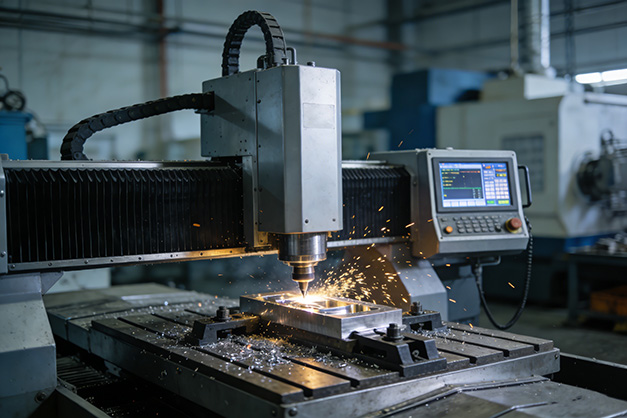
What is Face Milling?
Face milling, also known as slab milling, is the most fundamental and common type of milling operation. Its core purpose is to produce smooth, flat surfaces with specific dimensions and accuracy on a workpiece. You can think of it as a "surface planing and shaping technique for metal or plastic." It uses a rotating multi-tooth cutter (milling cutter) to cut a workpiece fixed on a table, removing material layer by layer to achieve the desired surface.
Core Working Principle of Face Milling
Tool and Motion: A cylindrical or face milling cutter equipped with multiple cutting edges rotates at high speed; this is the primary cutting motion.
Workpiece and Feed: The workpiece is securely clamped onto the machine table, which moves the workpiece in a linear feed motion relative to the cutter.
Cutting Process: The rotating cutting edges successively engage the workpiece material, removing chips. By precisely controlling the cutter's rotational speed, the workpiece's feed rate, and the depth of cut, accurate control over surface dimensions, flatness, and finish quality is achieved.
The Face Milling Process
Face milling is a fundamental machining process that uses a rotating cutter to efficiently produce flat surfaces with high precision and excellent flatness.
Core Application Scenarios:
Creating Datum Surfaces: Provides an accurate locating foundation for all subsequent machining operations.
Machining Assembly Surfaces: Such as enclosures, molds, cylinder blocks, and other large-area surfaces requiring tight fit or sealing.
Forming Steps and Cavity Bottoms: Precisely controls part height, thickness, and depth dimensions.
At wsrcnc Parts, this process is the cornerstone for ensuring every part possesses exceptional accuracy and reliability from the very first step.
Face Milling Application Scenarios
Aerospace: Aircraft wing panels, engine mounting surfaces, door track rails.
Mold Making: Injection mold parting lines, die-casting mold base plates, stamping die mounting surfaces.
Energy Equipment: Wind turbine gearbox faces, nuclear power flange sealing surfaces, hydraulic valve block faces.
Automotive Manufacturing: Engine block deck faces, transmission mating surfaces, chassis mounting faces.
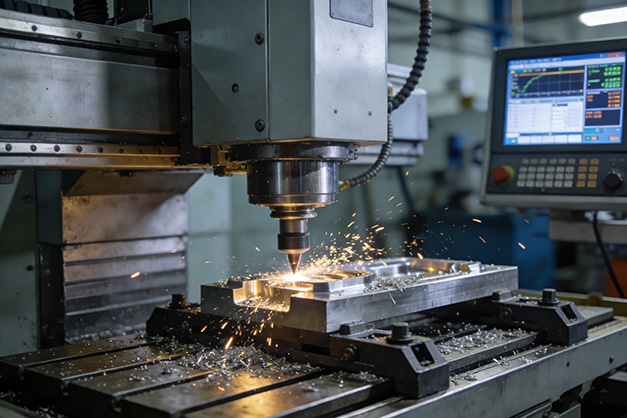
Advantages of Face Milling
High Efficiency: Multiple teeth cut simultaneously, with material removal rates 3-5 times higher than end milling.
Stability: Cutting force variation is smooth, resulting in minimal vibration.
Cost-Effectiveness: Insert cost is distributed across multiple cutting edges.
Limitations of Face Milling
High Machine Tool Requirements: Requires sufficient spindle power and machine rigidity (e.g., spindle torque T ≥ 200 Nm).
Stringent Workholding Needs: Requires large-area stable support; thin-walled parts are prone to distortion; clamping force must be evenly distributed.
Tooling Limitations: Minimum machining diameter is typically ≥ 32mm; internal corners cannot be machined; long tool overhang affects surface finish.
Common Issues in Face Milling and Solutions
| Problem Phenomenon | Likely Causes | Solutions |
|---|---|---|
| Visible Stepover Marks | Excessive tool runout; insufficient stepover overlap | Use an adjustable cutter body; increase overlap to 50% |
| Surface Chatter Marks | Improper cutting parameters; insufficient system rigidity | Reduce feed per tooth; decrease radial depth of cut |
| Rapid Tool Wear | Excessive cutting speed; insufficient coolant | Optimize cutting speed (vc) parameters; improve coolant delivery |
| Flatness Out of Tolerance | Workpiece distortion; machine tool geometric inaccuracy | Optimize workholding setup; perform machine tool accuracy inspection |
Summary
Face milling, as the core process for flat surface machining, holds an irreplaceable advantage in high-volume, high-precision, and high-efficiency applications. Modern face milling has evolved into a systems engineering approach integrating precision tooling, intelligent control, and optimized processes.
Best Practice Recommendations:
Tooling Investment: Select high-quality indexable face milling cutter systems.
Process Development: Establish parameter databases for different materials.
Quality Control: Implement Statistical Process Control (SPC).
Continuous Improvement: Monitor tool consumption to optimize machining costs.
For manufacturing enterprises, mastering the in-depth technical details of the face milling process is not only essential for enhancing machining capability but also a critical path to reducing manufacturing costs and improving product competitiveness.


