


Are your precision parts suffering from surface oxidation, scratch damage, or corrosion? Black anodizing is the professional solution you need. This advanced metal surface treatment technology builds a dense ceramic protective layer on aluminum alloy surfaces, providing comprehensive performance improvements.
As a proven aluminum surface treatment process, black anodizing not only significantly enhances parts' wear and corrosion resistance, but also creates a deep black hue for a decorative effect. Professionally treated CNC-machined parts achieve a uniform, consistent black appearance while maintaining precise dimensional stability, without compromising assembly accuracy.

What is black anodizing?
Black anodizing is an advanced metal surface treatment technology that acts like a durable "protective coat" for metal parts. It electrochemically builds a dense, aluminum oxide ceramic layer on the surface of aluminum and aluminum alloys. Then, through organic dyeing and high-temperature sealing, a permanent black protective film is formed. Even more remarkable, this protective film is covered in invisible micropores, absorbing the black dye like a sponge. After the parts are dyed a deep, inky black, they undergo a critical hot water sealing process to permanently seal the micropores. This process not only locks in the rich black color but also imparts a "superpower" to the surface that resists scratching and corrosion. It is widely used in the manufacture of demanding components in fields such as aerospace, precision instruments, automotive manufacturing, and the electronics industry.
How does black anodizing work?
Black anodizing is an electrochemical process that enhances the appearance and durability of aluminum. It forms a strong protective layer on the surface, then dyes it black and seals it to ensure long-term performance. The process involves several key stages, each crucial to achieving a smooth, deep black surface.
1. Surface Cleaning
Before anodizing, the part surface must be thoroughly cleaned to prepare a perfect "canvas" for the subsequent steps.
Alkaline Cleaning: A special alkaline solution is used to remove grease, dirt, and fingerprints that may have accumulated during machining.
Acid Activation (Etching): The part is immersed in an acidic solution to dissolve the thin, uneven natural oxide film that naturally forms on the aluminum surface. Rinsing with Clean Water: After each chemical treatment step, rinse thoroughly with deionized water to prevent cross-contamination of the solutions.
2. Anodization
Anodization is the core electrochemical process of the entire process.
Setting up the electrolytic cell: A pre-treated, clean aluminum component serves as the anode (connected to the positive power supply) and is suspended in a tank containing an acidic electrolyte (usually sulfuric acid or oxalic acid). The cathode (connected to the negative power supply) is typically composed of a lead plate or stainless steel plate.
Power-on Reaction: When a DC power supply is applied, the following key reactions occur:
At the anode (aluminum component), aluminum atoms are oxidized, losing electrons and becoming aluminum ions: 2Al → 2Al³⁺ + 6e⁻
Simultaneously, water molecules in the electrolyte are electrolyzed at the anode interface, generating oxygen: 3H₂O → O₂ + 6H⁺ + 6e⁻
The newly formed, highly reactive aluminum ions (Al³⁺) immediately combine with oxygen to form an extremely hard aluminum oxide (Al₂O₃) layer. Forming a Porous Structure: This oxidation process is unique in that it self-assembles into a highly ordered, porous honeycomb structure. Approximately two-thirds of the aluminum oxide layer grows into the substrate, and one-third grows toward the surface, leaving the original dimensions of the part virtually unchanged. This is crucial for precision parts.
3. Adsorption Dyeing
Dye Adsorption: The oxidized part is immersed in a solution containing a black organic dye. Due to the strong adsorption capacity of the oxide film, the dye molecules are absorbed deep into the film through the micropores.
Once the anodized layer is formed, it is ready for coloring. The part is immersed in a dye bath, where the tiny pores in the oxide layer absorb the black dye. This step creates a deep, rich black color. The longer the part is immersed in the dye bath, the darker and more uniform the color.
4. Sealing
The final step is sealing. The anodized part is treated with hot water or steam to seal the micropores in the surface. This locks in the black dye and enhances protection against corrosion and wear. A well-sealed anodized surface is smooth to the touch, durable, and resistant to fading.
What materials can be black anodized? Not all metals are suitable for anodizing. This process is primarily suitable for aluminum and aluminum alloys, as they naturally form a high-quality oxide layer. Other metals, such as steel, titanium, or stainless steel, often require different black treatments (such as blackening, black oxidation, or PVD coating) to achieve similar results. These processes differ fundamentally from traditional anodizing in principle.
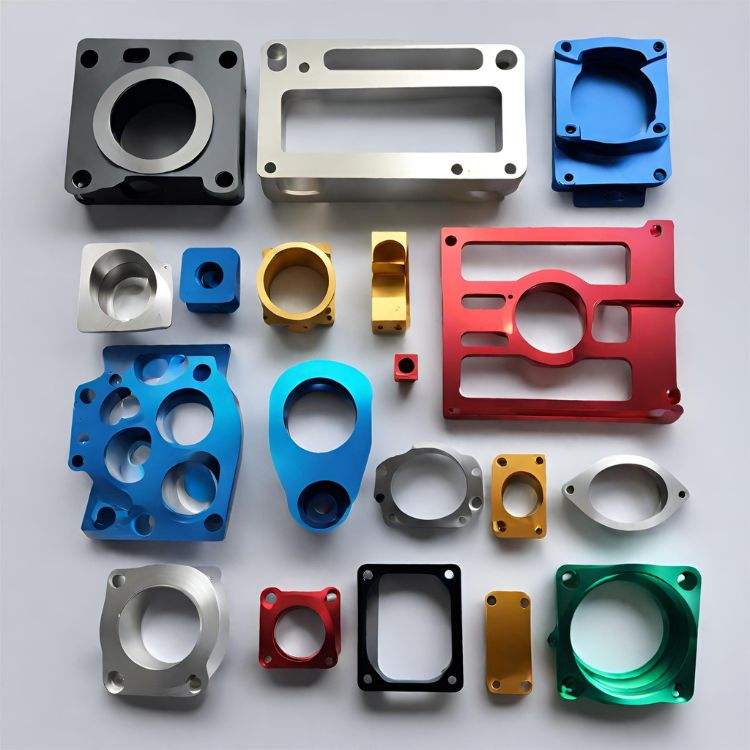
Table of Materials Suitable for Black Anodizing and Similar Black Treatments
| Material Category | Example Models/Types | Process Name | Result & Characteristics | Primary Application Fields |
|---|---|---|---|---|
| Aluminum & Aluminum Alloys (Most Suitable) | 6061, 6063, 7075, 5052, etc. | Anodizing + Dyeing | True black anodizing. The oxide layer is hard, wear-resistant, and corrosion-resistant. The black color is uniform and stable. Performance can be further enhanced by sealing. | Consumer electronics housings (phones, laptops), automotive parts, aerospace components, optical instruments, outdoor equipment |
| Titanium & Titanium Alloys | CP2, CP4, TC4 (Gr5), etc. | Anodizing | Creates an interference film on the surface by adjusting the voltage, producing various colors (including black). The layer is thin, vibrant but less wear-resistant. Not a traditional dyeing process. | Medical implants, surgical instruments, premium eyewear frames, jewelry, sporting goods |
| Steel / Cast Iron | Various carbon steels, alloy steels | Black Oxide (Room Temp/High Temp) | Not anodizing. A chemical process that creates a black or blue-black magnetite (Fe₃O₄) layer. The coating is thin, offers minimal rust prevention, and is mainly used for aesthetics and reducing light reflection. | Tools, firearm components, mechanical structural parts, fasteners (screws, nuts) |
| Stainless Steel | 304, 316, etc. | Chemical Coloring (INCO Method) or PVD | Not anodizing. Chemical coloring uses a specific solution to create a black oxide layer; PVD (Physical Vapor Deposition) applies a thin black film (e.g., Titanium Nitride). The latter is more wear and corrosion-resistant. | High-end kitchen & bathroom hardware, architectural decoration, watch cases, medical instruments |
When selecting the most appropriate material and process, it's important to consider the specific requirements for corrosion resistance, wear resistance, cosmetic appearance, and cost.
Advantages of Black Anodizing
Black anodizing is widely used due to its excellent protective properties, aesthetics, and functionality. Its excellent corrosion resistance: The anodized layer forms a dense protective barrier on the metal surface, effectively resisting moisture, salt spray, and chemical attack, making it particularly suitable for outdoor and harsh industrial environments.
High Scratch and Abrasion Resistance: The hardened surface significantly improves the material's resistance to mechanical damage, helping to maintain the component's long-term cosmetic integrity and service life.
Durable, uniform matte black appearance
The black dye is absorbed and permanently sealed into the oxide layer, creating a smooth, non-flaking matte or semi-gloss finish widely used in consumer electronics and industrial products.
Enhanced coating and adhesive adhesion
The microporous anodized surface provides an ideal adhesion base for paints, printed coatings, and adhesives, making it suitable for applications requiring secondary processing or branding.
Environmentally friendly surface treatment
Compared to traditional electroplating or spray painting, the anodizing process is water-based and produces virtually no hazardous waste. The treated aluminum is also fully recyclable, meeting sustainable manufacturing requirements.
Excellent thermal stability and chemical resistance
The oxide layer is stable in moderately high temperatures and resists corrosion from a variety of industrial solvents, making it suitable for component processing in the chemical, automotive, and other industries.
Limitations of Black Anodizing
Despite its many advantages, black anodizing still has the following limitations to consider when selecting materials and designing products:
Non-conductive surface
The anodized film is an electrically insulating layer, making it unsuitable for contacting components requiring electrical grounding or signal transmission.
Limited Material Applicability
This process is primarily suitable for aluminum and aluminum alloys. Other metals, such as steel and copper, cannot be effectively treated directly and require alternative blackening processes.
Strict Process Control Requirements
Slight variations in factors such as alloy composition, electrolyte parameters, and sealing time can result in color inconsistency, requiring strict process control to ensure uniform appearance.
Limited Impact Resistance
Despite high surface hardness, the oxide layer is relatively thin. Under high impact or extreme wear conditions, hard anodizing or electroplating may be more suitable.
Induces Slight Dimensional Variation
The oxide film adds approximately 0.001–0.002 inches to the part's thickness, which must be compensated for in high-precision or close-tolerance assembly.
Controlling Deep Black Tones is Costly
Achieving a consistent, deep black effect from batch to batch requires the use of high-grade dyes and enhanced process control, which increases process complexity and cost.
| Aspect | Advantages | Limitations |
|---|---|---|
| Appearance | Deep, uniform, and elegant black color that enhances product aesthetics. | Potential for color variation between batches; color is limited to black. |
| Performance | High hardness, excellent wear and corrosion resistance, electrically insulating. | The coating is relatively brittle and can crack under impact; it is non-conductive. |
| Functionality | Excellent adhesion for secondary processing; maintains dimensional stability. | Scratches from sharp objects are highly visible (exposing the silver substrate). |
| Material Compatibility | Optimal results are achieved with aluminum and its alloys. | Primarily suitable only for aluminum and its alloys. |
| Process & Cost | Provides exceptional performance and high added value. | Complex process, demands high-quality pre-treatment, resulting in higher costs. |
| Environmental Impact | The final coating is safe and non-toxic. | The production process generates chemical waste that requires treatment. |
Why Anodize CNC Parts?
When purchasing CNC aluminum alloy parts, black anodizing not only enhances visual quality but also significantly improves durability and functionality. This process creates a dense oxide layer on the surface, effectively concealing subtle marks caused by CNC machining. This creates a hard, wear-resistant protective film, ensuring the parts maintain their pristine appearance and stable performance even under harsh conditions.
The deep, uniform black surface imparts a high-end, professional quality to the product while ensuring dimensional accuracy. Whether used in precision electronic housings, automotive components, or industrial equipment, black anodizing offers an ideal balance of aesthetics, durability, and dimensional control, making it a preferred solution for both quality and practicality.
Applications of Black Anodized Parts in Various Industries
Due to its unique performance and aesthetic value, black anodizing has become an indispensable surface treatment in numerous industries. It successfully combines functionality, durability, and a high-end appearance. Below is a detailed analysis of its applications in various industries. 1. Consumer Electronics 1:Industry
Smartphone midframes and casings, laptop bodies, tablet back panels, headphones, smart wearable device casings, power banks, etc. These are common applications.
2. Automotive Industry
Applications: Center console buttons, knobs, decorative strips, steering wheel logos, speaker covers. Air intake grilles, door handles, rearview mirror casings, vehicle logos. Engine compartment brackets, radiator components, and suspension components.
3. Aerospace and Defense
Applications: UAV fuselages and gimbal components, optical equipment barrels and brackets, satellite components, helmet accessories, weapon sight casings, etc.
4. Industrial Equipment and Automation
Applications: Robotic arms and joint components, linear guide slides, sensor casings, fixtures, precision measuring instrument casings, control panels, etc.
5. Medical Device Industry
Applications: Endoscope casings, surgical instrument handles, medical cart components, diagnostic equipment casings, prosthetic and exoskeleton components.
6. High-End Outdoor and Consumer Products
Applications: High-end bicycle frames and components, carabiners, tactical flashlights, knives, premium stationery (such as pen barrels), and audio equipment (such as hi-fi players).
Black anodized aluminum gives your CNC parts the perfect blend of durability, style, and precision. It's more than just a surface treatment; it elevates product quality.
At WSR CNC, we deeply understand the value of materials and craftsmanship. Therefore, we offer not only precision CNC machining capabilities but also professional surface treatments, including superior black anodizing, ensuring your projects are marketable from the inside out.
Contact our expert team today for a free, customized project quote and solutions, allowing professional craftsmanship to empower your creativity.


